Thursday, September 17, 2015

3D Character and Environment Design for Animation

Character development

Pre-production

The concept that might be attachable in my character from this character is the farmer hat and the costume. As in Mantin, a huge count of farms and orchards are belonged by the Bhuddist of Mantin and from other places too. So, a name for my Character is given which is ‘Ah Soon’.  After considering the concepts and look of the farmer, ideas are generated as planned and sketched to produce a suitable character of my own project.

These are the sketches of my character development:

photo 1 : sketch for character development


photo 2 : sketch for character development


photo 3 : sketch for character development


photo 4 : sketch for character development


photo 5 : sketch for character development

These are the my developing process to create a perfect character as how i wanted.


Wednesday, September 16, 2015

Interactive Design for Web Technology

User Experience, User Interaction, and User Interface Design

User Experience, User Interaction, and User Interface Design, are all terms that describe the role of a web designer in determining a user’s experience when using a web application. User Experience (UX), User Interaction (UI), and User Interface (UI) Design, are all terms that describe the role of a web designer in determining a user’s experience when using a web application.

User Interaction


Connecting with your website visitors

The people visiting a site must interact with the content if want to capture their attention. Engaging the visitors in an exchange of ideas that leads to some desirable action is accomplished through interactivity.
By creating an interaction between the people who enter a website and its contents the likelihood of holding their attention and producing a desirable effect is greatly enhanced. Interactivity, intelligently applied, cultivates a bond between website designer and the visitors.
How you develop interactivity depends upon the content that you are introducing to your visitor. Some people willing to interact while others choose to browse the content silently. The type of participation by the people who enter the site is irrelevant if the material selected are proffering on what they are looking for.

By giving them something that they want, visitors will tend to respond to ideas in a positive manner. In order to illicit a response from the people who are visiting the website we must give them something that they need.

Interacting with target audience
The presentation of quality content that informs should be the first and foremost consideration. People will usually visit your website seeking information about the subject matter you are presenting. Therefore, to interact with this target audience your site content must have a focus or central website theme. Your site should have a locus that highlights the subject matter at hand. Not only does this help in attracting a targeted audience to your website but it is also key to website optimization.

Credibility
The target audience will interact with website if they like what they see. They are the people who will most likely buy the product and/or accept ideas. By providing information or data that the visitors are seeking, we will enhance the credibility with them. Based on content and how it is being presented the trustworthiness of our website will be judged.

Trust
Through the presentation of logical argument and a call to action you can develop an atmosphere of trust with visitors. By proceed through content in steps building toward a conclusion that calls for a definite response we can bridge the credibility gap with the people visiting our site. In other words, the website content should be structured in such a way as to progress from general information to specific data.

Interactivity
You will need to provide a means by which visitors are free to interact with us. This is a critical and reliable source of feedback. We can learn how effectively are the promoting of our message by the type of feedback received. Make sure that visitors have means of expressing their views and it will be able to intelligently build a winning website from the feedback received from them.
Message forums, e-mail contacts, surveys, registration and order forms are all effective methods of soliciting data from your target audience. Anything that allows visitors to connect with you will increase user interaction. Always respect their privacy and let them know that you will keep all correspondence in confidence. As time goes by your website will develop a reputation of authority.

Respond to your website visitors
Respond promptly to e-mails from visitors. Let them know of how we value their comments and appreciate what they have to say. Often they will offer suggestions that we can use to improve the site.

Feedback
One of the ways that the visitors provide with feedback is through their criticisms. Take note of what they have to say. This is one of the most useful sources of information on how message is being received by the people entering our website. Foster user interaction in any way that we can and build upon what had learnt.


(2013). What users do, and why they do it: what is user experience and why it is so important? [Online] Available on: http://whatusersdo.com/clients/resources/what-is-user-experience. [Accessed on: 19 September 2015]

(2009). How to design a website: user interaction; connecting you’re your website visitors. [Online] Available on: http://www.rocketface.com/implement_website/user_interaction.html [Accessed on: 19 September 2015]


Skillcrush. (2012). Skillcrush: user experience, user interaction and interface design. [Online] Available on: skillcrush.com/2012/09/17/user-experience-user-interaction-and-user-interface-design/ [Accessed on: 19 September 2015]

Tuesday, September 15, 2015

Interactive Design for Web Technology

What is User Experience and why is it so important?

What is the User Experience?
The User Experience is everything that happens to the users when they interact with our business or organisation via website, application or online communications. It includes everything they see, hear and do as well as their emotional reactions.

Why is the User Experience so important?

For many years, hugely successful companies like Google, Twitter, eBay and Amazon have recognised that the User Experience has a direct impact on their bottom line. These companies didn't succeed by chance. They continuously test every aspect of their business with real users to ensure high levels of customer satisfaction. That's because on the internet, the customer is king. At any point our visitors can opt to leave the website and go elsewhere - usually to a competitor. We have all experienced this when we've visited a website that was slow or buggy or simply made it difficult for us to achieve our objectives.
Common sense tells us that if users can't find information easily or have trouble buying our products they will quickly leave the website and shop elsewhere and they won't come back. E-consultancy identified that a good User Experience: increases Sales and online conversions improves brand perception improves Google search rankings reduces customer dis-satisfaction and churn reduces the costs of development and support.


What is User Experience Testing?
User Experience Testing has several names; UX Testing, usability testing, user testing; they all refer to the process of understanding what users do and why they do it.
Traditional user testing involves individual test participants who are recruited to sit at a computer and be observed carrying out tasks that they are given. The process of watching and listening to real people carry out these tasks provides a great insight into what works and what doesn't, and critically - WHY.
Traditional usability testing is very effective but it is time consuming and expensive and, as a result, few organisations invest in it. We believe that everybody should be able to reap the benefits of UX testing so we created What Users Do to make the whole process faster, easier, and much, much cheaper. For everyone. It sounds simple. And it is. But it is an extremely effective way of helping to understand what we can do to improve the user experience and increase sales, build brand loyalty and grow the number of customers coming to our website.

How does User Experience?
User Experience testing is an opportunity to see our website (or any digital content) from the perspective of a real user. It’s about observing what people actually do and hearing what they think as they interact with the website, application or marketing. It’s the best way to discover what works (so you can do it more) and what doesn't and WHY. Then fix it.
If we use analytics software (like Google Analytics or Omniture) then our conversion goals, funnels and statistics will tell a great deal about what happens on our website. User experience testing tells WHY.
-Why our users stay and why they leave
-Why they buy and why they don't
-Why they pay and why they abandon their shopping carts
-Why they buy from our competitors and not from you

In fact, we can test pretty much anything and find out what our users do and why they do it.

Reflection:
From this note, I have understand on the importance of knowing the user experience on using a specific site. Few important questioning should be done to understand the users need and what is left or what could be an advantage of our website.

Reference:


(2013). What users do, and why they do it: what is user experience and why it is so important? [Online] Available on: http://whatusersdo.com/clients/resources/what-is-user-experience. [Accessed on: 19 September 2015]

(2009). How to design a website: user interaction; connecting you’re your website visitors. [Online] Available on: http://www.rocketface.com/implement_website/user_interaction.html [Accessed on: 19 September 2015]

Skillcrush. (2012). Skillcrush: user experience, user interaction and interface design. [Online] Available on: skillcrush.com/2012/09/17/user-experience-user-interaction-and-user-interface-design/ [Accessed on: 19 September 2015]


Thursday, September 10, 2015

Visit Art Expo expo observation images

Art Expo

A trip to Art Expo KL were organised by the school to allow the student to learn many thing and to generate more ideas from what and hoe they observe all the artwork in the expo.

These are the photos taken during the visit to the art expo (expo observation images 1-8):

expo observation images 1

expo observation images 2

expo observation images  3

expo observation images 4

expo observation images  5

expo observation images 6

expo observation images 7

expo observation images 9

reflection of this task:

From this trip to KL Art Expo, i have learnt on how to display the artwork in  a proper way neatly and by setting the environment to fit the art work as well. Other than, it helped me on determining the techniques and the medium that have been used to create all the artwork. It has been an opportunity for me to develop skills and use them into the module during working on to produce a quality and creative work.


Sunday, September 6, 2015

3D Character and Environment Design for Animation

Pre-Production

Character

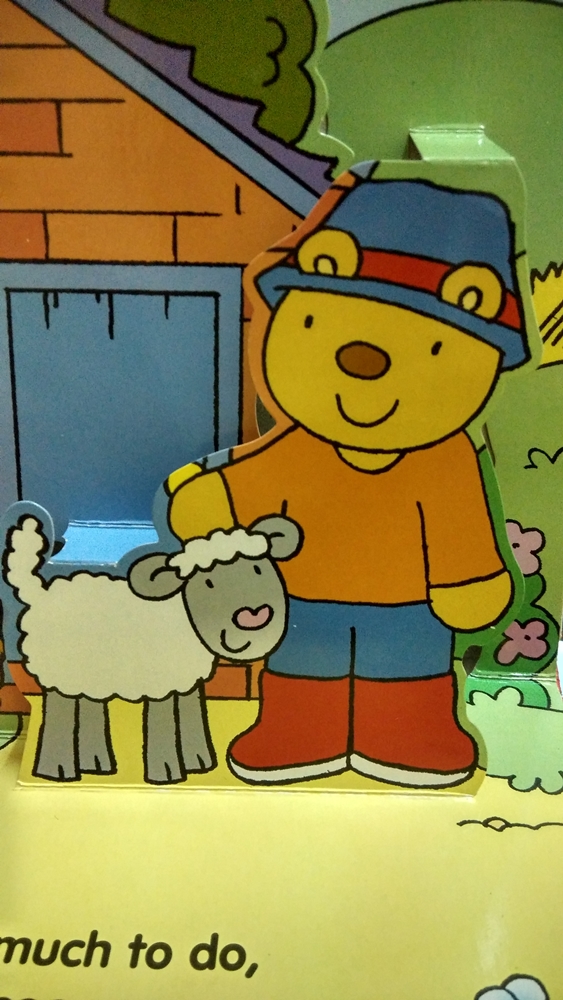
For the referencing progress of a character, a suitable example for a farming role which is related to my topic is from a preschool pop-up book which is titled The Alphabet Farm.
The book of character reference:

photo 1 : book of the character referred 


photo 2 : selected character


photo 3 : selected character


The main character that is shown in this book is the Farmer Bear.


The colours and the background of this story book is based on single line drawing in 2D, and on colour wise, soft and attractive colours were given to maintain the mood of the audience (children in preschools).

The features used for the character are suitable for the audience to understand that the character is a farmer. This is because, when a character is created, the audience must be able to understand the character and the concept by witnessing the character form and the additional features or props. As an example, a rubber boot and hat with a rake clearly shows that it is a farmer.

Friday, September 4, 2015

Principles of Marketing


Trademark


Distinctive design, graphics, logo, symbols, words, or any combination thereof that uniquely identifies a firm and or its goods or services, guarantees the item's genuineness, and gives it owner the legal rights to prevent the trademark's unauthorized use. 

A trademark must be:
(1) distinctive instead of descriptive
(2) affixed to the item sold, and
(3) registered with the appropriate authority 

....to obtain legal ownership and protection rights. Trademark rights are granted usually for 7 to 20 years and, unlike in case of patents, are renewable indefinitely. These rights are protected worldwide by international intellectual property treaties and may be assigned by their owner to other parties. Although a trademark has no limited term of existence, the rights to use it may be lost due to misuse or lack of use. Trademarks are divided into 42 international classes, each class representing similar goods or services. Whereas a trademark may be registered under multiple classes, it is protected only in the class(es) relevant to the business or trade area of the item. And, whereas the use of symbol 'TM' does not provide any legal benefit, it precludes the infringer's defense of lack of knowledge of a trademark claim. Costs incurred in design and registration of, and in defending, a trademark are usually amortized over the life the trademark or 40 years, whichever is shorter. In balance sheets, trademarks are identified as intangible assets and, in some cases such as Pepsi Co., are far more valuable than the firm's all other assets. The term trademark includes the associated term service mark (SM).


Logo

A logo is an element which is the most important one to mirror the identity of a company or the service that is provided. The logo efficiency is based on the principles of making a logo. There are 5 principles in designing a good logo and it is simplicity, versatile, memorable, timeless and appropriate.


1. Simple
Less is more. Logos that are overdrawn or too ornate are generally inflexible and have limited versatility.  Keeping a logo simple it enhances its “stickiness” and keeps it from being perceived as busy. Creating a unique concept and striping it down to the most basic level it can be while retaining its impact.

2. Memorable
In order for a logo to be memorable or have a “sticky” factor, it needs to be both simple and relevant or appropriate to the audience. The design should be simple enough to easily recall and convey imagery or typography that resonates with the target audience.

3. Timeless
For the business to stand the test of time; the brand needs to be just as timeless. A great logo will still be great 10-20 years from now. Re-branding should not be considered a normal part of business nor should it become a habit. Longevity is what should strive for. Creating a timeless logo, avoid trends, avoid unnecessary effects and keep it simple.

4. Versatile/Flexible
Will the logo work in one color or against a dark background? An effective logo works across various media and within different contexts. To ensure flexibility, starting by creating a logo in black and white. Using a vector format will enable the logo to scale to various sizes without losing quality.

5. Relevant & Appropriate
Understanding the target audience or consumer is an integral component of creating an effect logo design. Knowing what is appropriate for audience will dictate what font style used, the colors and any accompanying imagery. Designing the same logo for a toy company as would an automotive parts store.


reference:

Khan, A. (2014) Linkedin: 5 principles of effective logo design. [Online] Available on: https://www.linkedin.com/pulse/5-principles-effective-logo-design-asif-khan  [Accessed on:18 August 2015 ]

(2013) Business dictionary: trademark. [Online] Available on: http://www.businessdictionary.com/definition/trademark.html [Accessed on: 1 September]


Wednesday, September 2, 2015

3D Character and Environment Design for Animation

Character

A character is an identity for an animation according to the roles that it is played.  In computer graphics, a sprite is a two-dimensional image or animation that is integrated into a larger scene. Initially including just graphical objects handled separately from the memory bitmap of a video display, this now includes various manners of graphical overlays.
Requirement:
Develop a sprite character animation on 3D image.

What is a character?
A character is an identity for an animation according to the roles that it is played which has a special morality, psychological value and etc.

As my topic for this semester, it is about the farm/ orchards in Mantin. Regarding on that, a farmer or an orchard keeper would be a better look and choice of selection to be developed as my 3D animation sprite. The reason of selecting an orchard keeper is due to the Mantin economical factor. There are huge amount of orchards in Mantin which especially produces jackfruit and durian fruits a lot.